

 UK
UK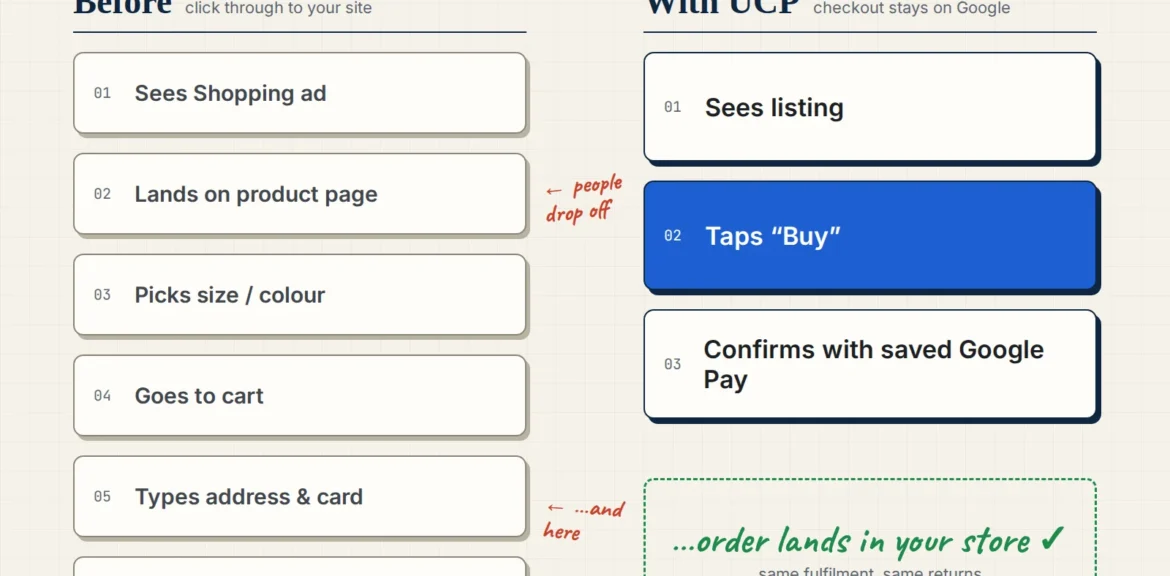

Google’s New “Buy” Button: What Retailers Need to Know
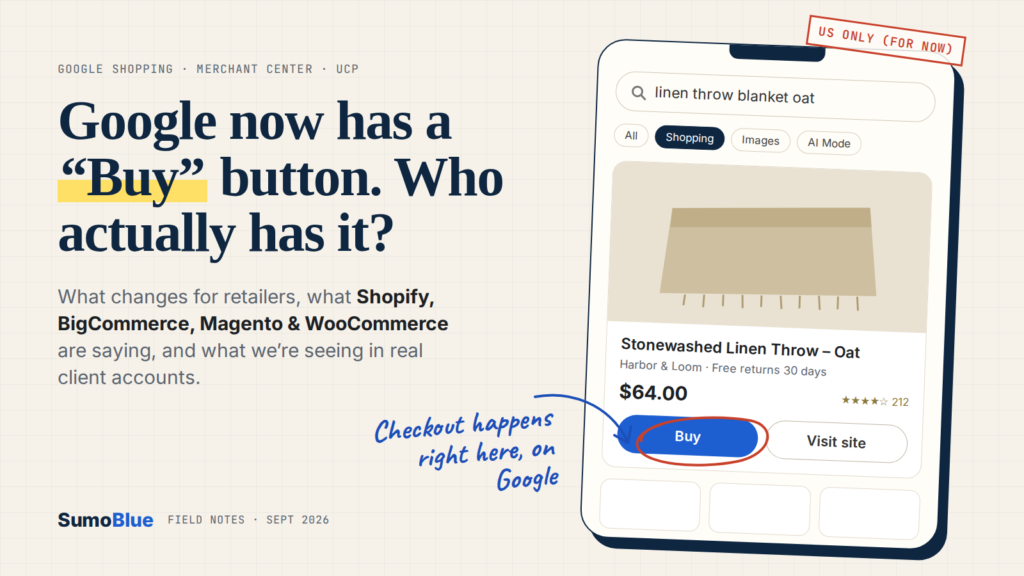
Google has quietly added a “Buy” button to product listings.
Tap it, pay with Google Pay, done. The shopper never lands on your website.
It’s called UCP checkout (short for Universal Commerce Protocol). And if you sell online, it’s the biggest change to Google Shopping since free listings.
Below: what it is in plain English, what Shopify, BigCommerce, Magento and WooCommerce are telling retailers, and what we’re actually seeing in client Merchant Center accounts. Let’s get into it.
What is Google’s UCP checkout?
Here’s the short version:
UCP lets a shopper buy your product directly on Google, using the card and address already saved in their Google account.
Google launched the Universal Commerce Protocol in January 2026. It was co-developed with Shopify, Etsy, Wayfair, Target and Walmart, and backed by 20+ others including Adyen, Mastercard, Stripe and Visa.
At first the checkout only showed up in AI Mode and the Gemini app. Then in May, Semrush reported the “Buy” button showing on regular Google Search results too, on Wayfair listings. Same month, at Google Marketing Live, Google announced a Universal Cart that works across retailers.
So this isn’t a lab experiment any more. It’s rolling out on Google’s main search results page.
The part most people miss
You stay the merchant of record. The order comes into your store, you ship it, you handle the return. Only where the checkout happens moves.
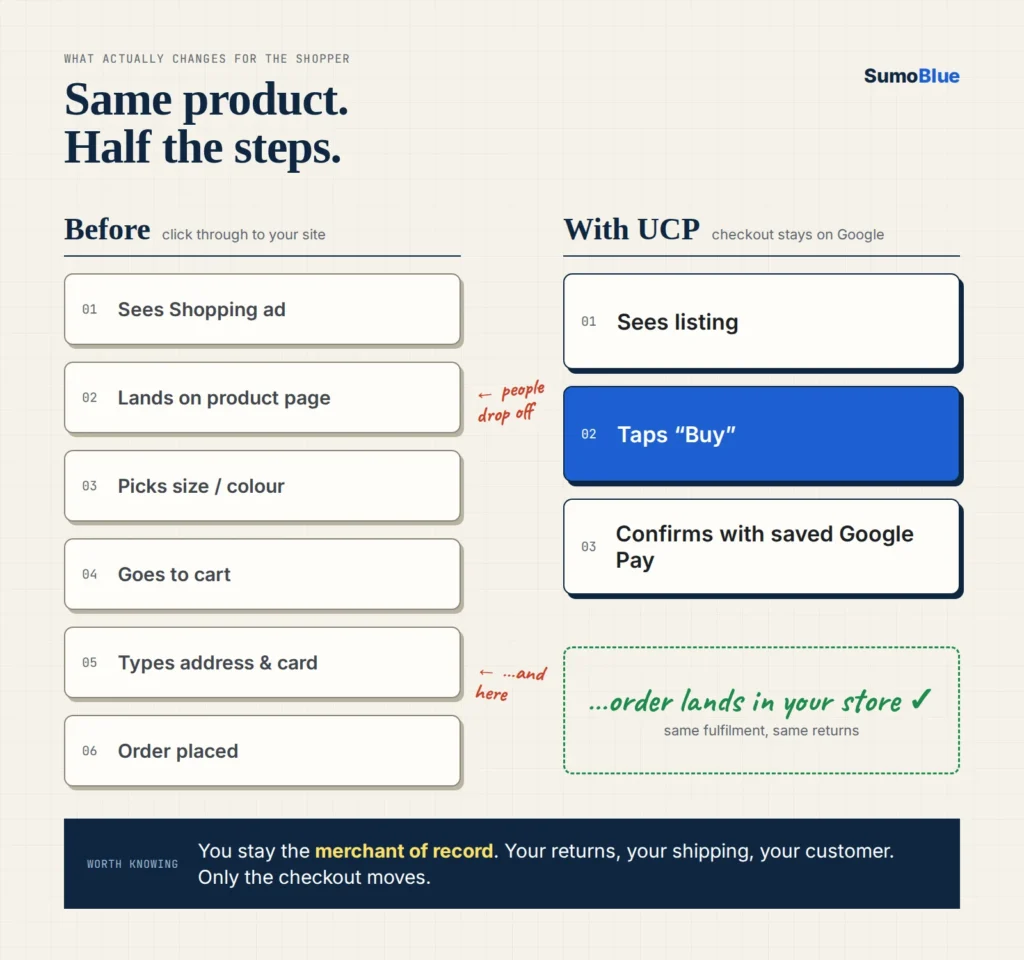
Right now a Shopping click has to survive a product page, a size picker, a cart and a checkout form. Every step is a chance to lose the sale. With UCP, most of that disappears.
Who can use it right now?
Google’s own help article says the feature applies to products in the United States, Canada and Australia, for “select merchants” only. At Google Marketing Live, Google said the UK comes later.
Ireland and the rest of Europe? Not mentioned yet. But the official line only tells half the story, so we went and checked.
What we’re seeing in client accounts (late September 2026)
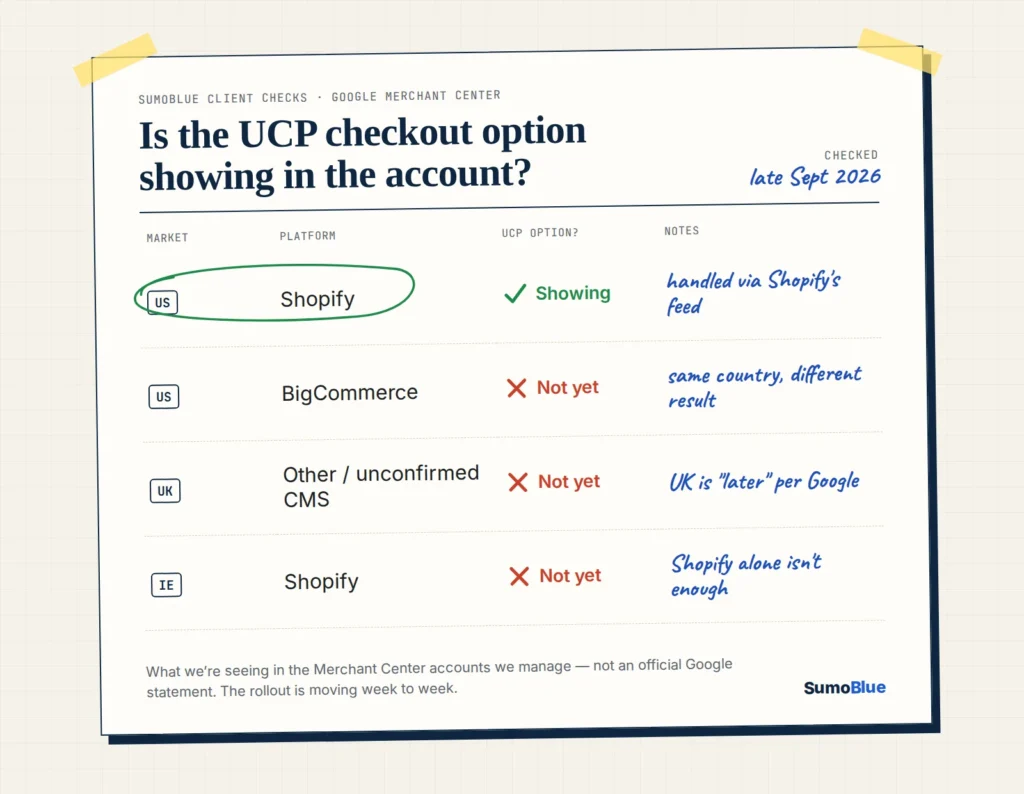
Here’s what the UCP option looks like across the Irish, UK and US accounts we manage this week:
- US retailer on Shopify: ✅ UCP option showing
- US retailer on BigCommerce: ❌ Not showing
- UK retailer on a different platform: ❌ Not showing
- Irish retailer on Shopify: ❌ Not showing
Being in the US isn’t enough (our US BigCommerce client doesn’t have it). Being on Shopify isn’t enough either (our Irish Shopify client doesn’t have it). Right now you need both.
The Shopify anecdote
This surprised me. On the US Shopify account, we didn’t build anything. No supplemental feed, no custom attribute, no developer. The option was just there.
From what we can see, the Shopify feed is effectively approving products for UCP on the retailer’s behalf. Shopify is handling the technical plumbing in the background.
That lines up with Shopify’s own help centre, which says direct checkout in Google AI Mode and Gemini is “activated by default for eligible stores.”
Important: this is what we’re seeing in the accounts we manage. It isn’t an official Google statement, and the rollout is shifting week to week. If you’re seeing something different, I’d genuinely like to hear about it.
What Google says you need
If you’re not on Shopify, here’s Google’s list, in plain English:
- A healthy Merchant Center account with products approved for free listings.
- A return policy in Merchant Center: return cost, return window and a link. It’s shown at checkout.
- Customer support details: a help page, email or phone number.
- A new product attribute:
native_commerce(checkout_eligibility)set toTRUE. No attribute means no Buy button. Google recommends adding it with a supplemental feed so you don’t break your main feed. - Matching product IDs between your feed and checkout (or mapped with
merchant_item_id). - A Google Pay & Wallet Console account, with your payment provider connected to the Google Pay API.
- The technical build: a UCP profile on your domain plus checkout endpoints. Developer work.
- Google’s interest form. It’s still early access.
Products that can’t use it (yet)
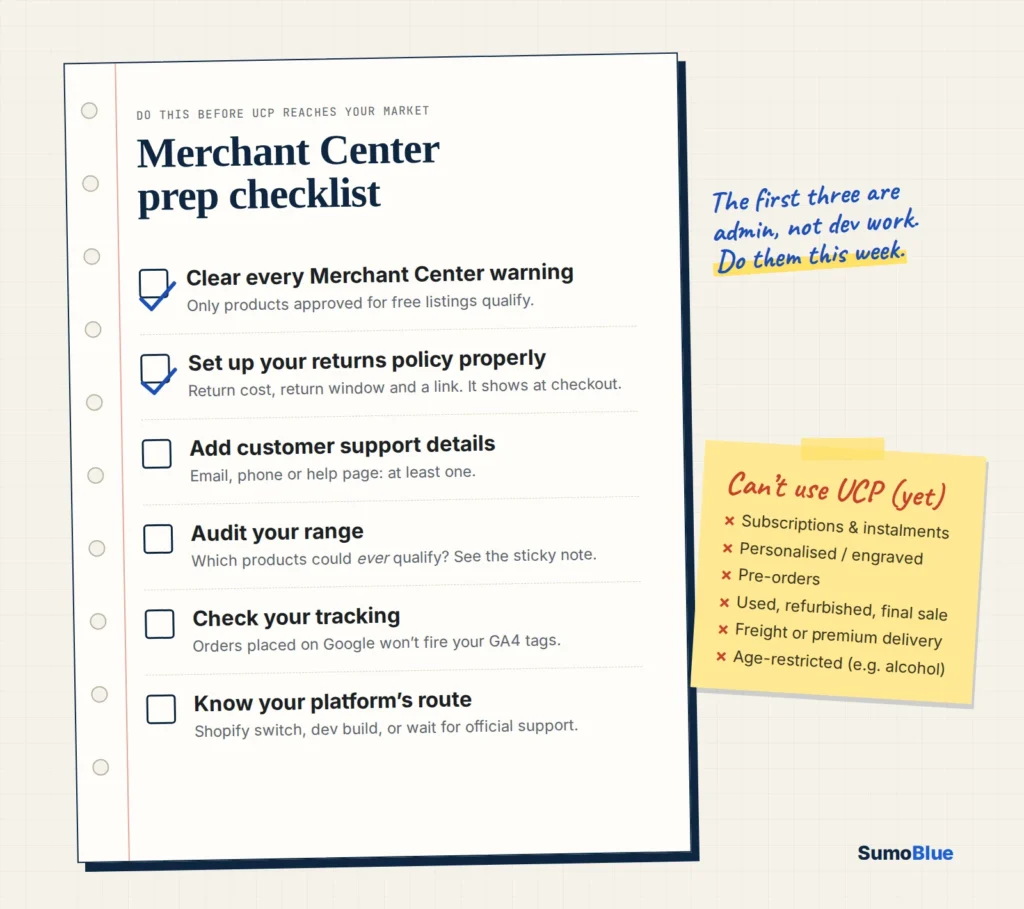
Even if you get set up, Google excludes subscriptions, instalment plans, personalised items, pre-orders, used or “final sale” stock, freight items and age-restricted products like alcohol. (They’re summarised on the checklist further down.)
So if half your range is made-to-order, UCP will only ever cover part of your catalogue.
What each ecommerce platform is saying
The question we keep getting: “Do I need to do anything?” Honestly, it depends almost entirely on your platform.
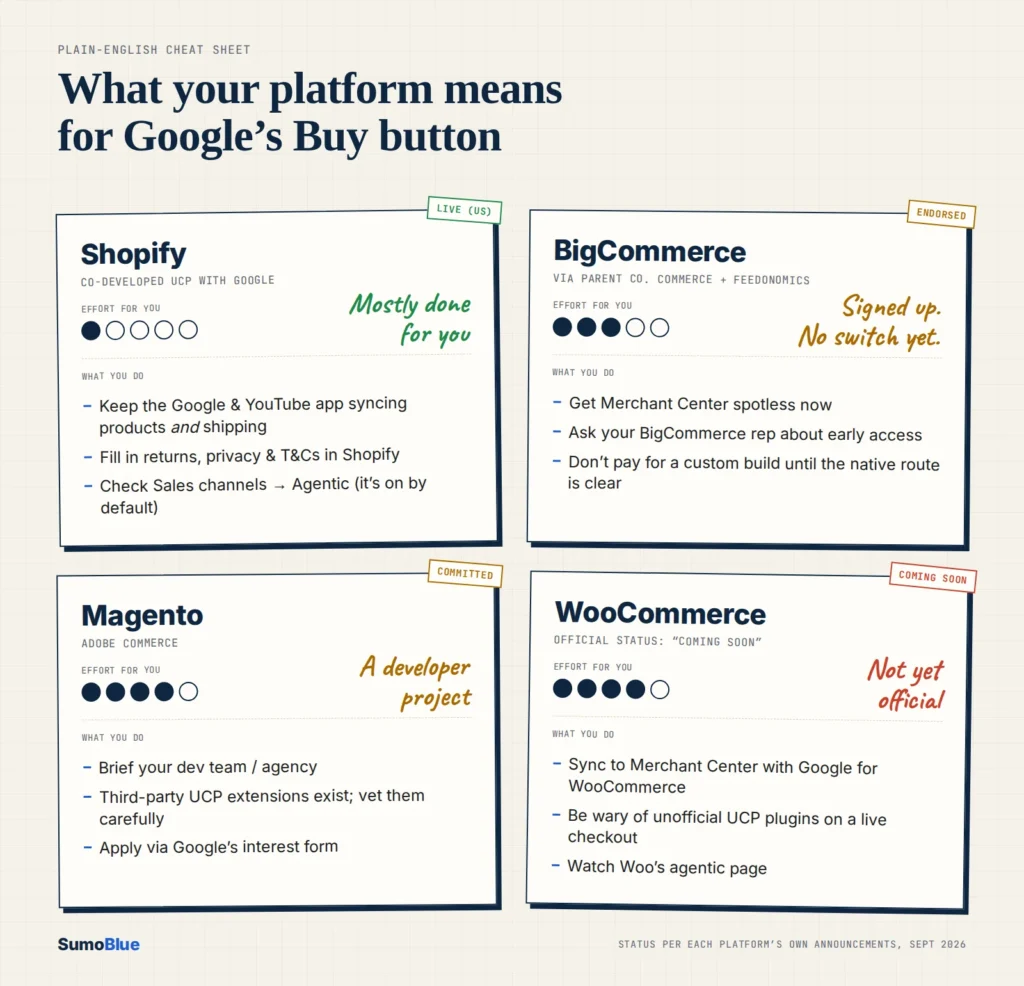
1. Shopify: mostly done for you
Shopify co-built UCP with Google, so it’s furthest ahead. It runs this through Agentic Storefronts, and the rules are:
- Your store must be based in the US and selling to US customers
- Products in Merchant Center via the Google & YouTube app (product and shipping sync on) or a third-party feed
- Terms, privacy and returns policies filled in under Settings → Policies
- Direct checkout is on by default, with no fees beyond normal payment processing
If you want to switch it off: Sales channels → Agentic, turn off “Allow Shopify to manage for me,” then toggle direct checkout for Google AI Mode and Gemini.
Gaps: subscriptions, bundles, customisable and B2B-only products aren’t supported, nor is click-and-collect. Upsell and loyalty apps at checkout may not show.
Irish and UK Shopify retailers: nothing to switch on yet, but you’ll likely be first in line when Google opens your market. Keep your feed and policies clean.
2. BigCommerce: signed up, no switch yet
BigCommerce’s parent company, Commerce (which also owns Feedonomics), endorsed UCP on launch day in January. It said it plans to let merchants sell directly across Google’s AI surfaces.
But we haven’t found a merchant-facing “turn it on” setting like Shopify’s, and our US BigCommerce client doesn’t have the option.
What to do: get Merchant Center spotless, ask your BigCommerce account manager about early access, and hold off on paying for a custom build until the native route is clear.
3. Magento (Adobe Commerce): a developer project
At Adobe Summit in April, Adobe committed to supporting UCP (and OpenAI’s rival protocol, ACP). It also launched a Commerce MCP server that lets AI agents read your catalogue, cart and checkout.
In plain English: the foundations are there, but no simple toggle. Several third-party extensions claim to add UCP checkout; some are still “in progress.”
What to do: this sits with your developers or agency. Vet any extension carefully (it’s touching your checkout and payments), then apply through Google’s interest form.
4. WooCommerce: officially “coming soon”
WooCommerce’s public status table lists Google’s UCP as “Coming soon.” Woo says if you already sync to Merchant Center with Google for WooCommerce, “you have the foundation.”
My take: there are unofficial UCP plugins in the WordPress directory, but be very careful exposing your live checkout that way. Get the basics right and wait for the official release.
The catch nobody’s talking about: tracking
This one’s for anyone running Google Ads. Shopify says that in Google’s direct checkout, Google Analytics and custom pixels won’t fire. Only server-to-server events (checkout started and completed) come through.
So if a big slice of your Shopping sales moves to UCP, your GA4 reports and on-site conversion tags could under-count sales that really happened.
We treat conversion tracking as a launch blocker on every account, and UCP doesn’t change that. Check where these orders show up (Shopify lets you filter orders by agentic channel) and make sure Smart Bidding isn’t starved of data. We’ll update this post as we learn more.
Your UCP prep checklist
Whatever platform you’re on, these are worth doing now, before it reaches your market:
The first three are admin, not developer work. Get them done and you’ll be ready the week it lands.
The bottom line
Google’s Buy button is real, and it’s moving onto the main search results page. Right now, in the accounts we manage, it’s only showing for US retailers on Shopify. Not US BigCommerce. Not the UK. Not Irish Shopify stores.
But that’ll change. Google has already named the UK as a future market. And when it arrives, the retailers with clean feeds and proper policies will be first in the queue.
Not sure if your Merchant Center is ready? Book a strategy session with our team and we’ll tell you exactly where you stand.
Sources:
Google Merchant Center Help: About UCP checkout ·
Google for Developers: Prepare your Merchant Center account ·
Semrush: UCP expands to main SERP ·
Google: UCP updates at Google Marketing Live ·
Shopify Help: Selling on Google AI Mode and Gemini ·
Commerce (BigCommerce): UCP endorsement ·
Adobe: Agentic upgrades in Adobe Commerce ·
WooCommerce: Agentic commerce protocol status