

 UK
UK

There is a lot of noise around ChatGPT Ads right now.
Some of it is justified.
OpenAI has already introduced a beta self-serve Ads Manager, CPC bidding, CPM buying, pixel-based measurement and Conversions API. It has also said advertisers can create campaigns through partners or through the new beta Ads Manager.
That matters.
Because this is no longer just a vague “AI ads are coming” conversation.
The plumbing is being built.
But here is my early view:
ChatGPT Ads will not be won by the advertisers looking for shortcuts.
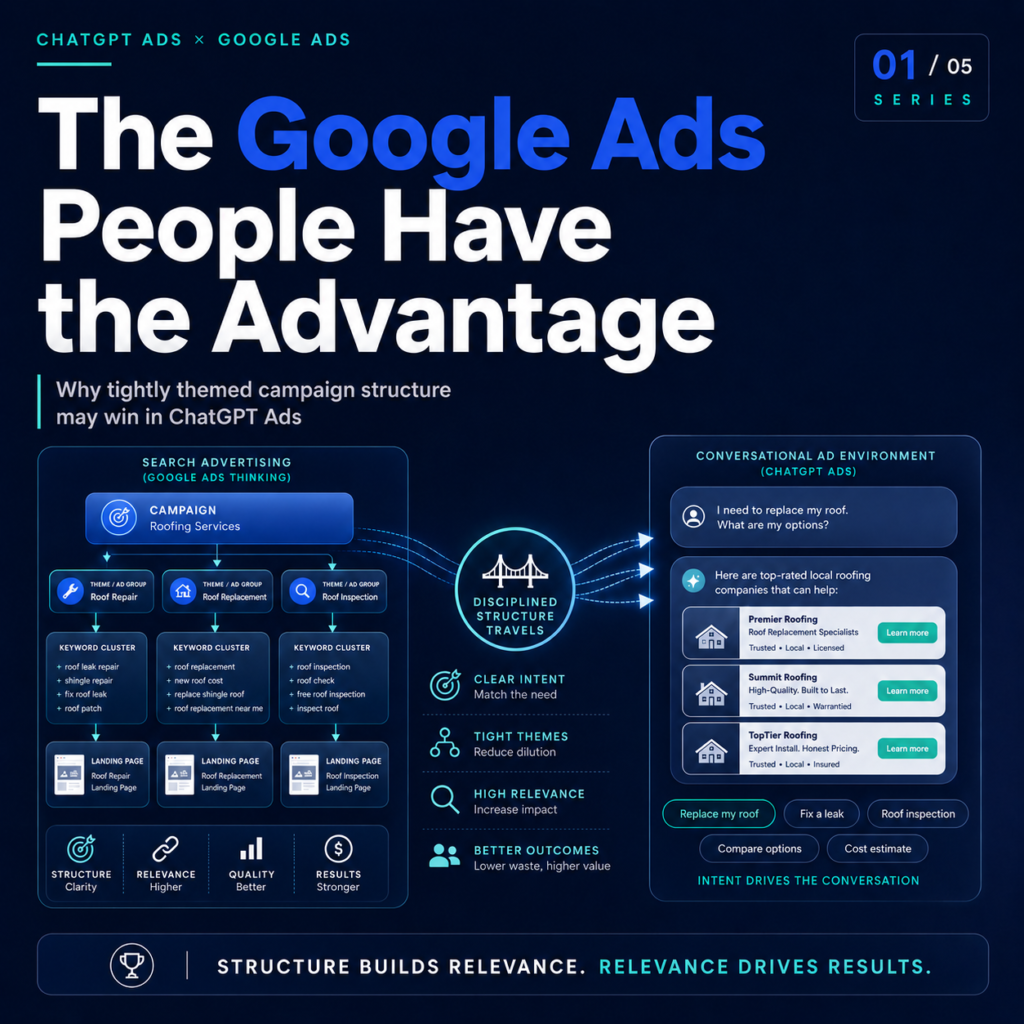
They will be won by the advertisers who understand intent.
The ones who know how to structure campaigns properly.
The ones who match messaging to landing pages.
The ones who know the difference between broad traffic and commercially useful traffic.
In other words, a lot of the same disciplines that have always separated good Google Ads management from bad Google Ads management.
The platform may be new.
The fundamentals are not.
ChatGPT Ads Are Not Just “Google Ads 2.0”
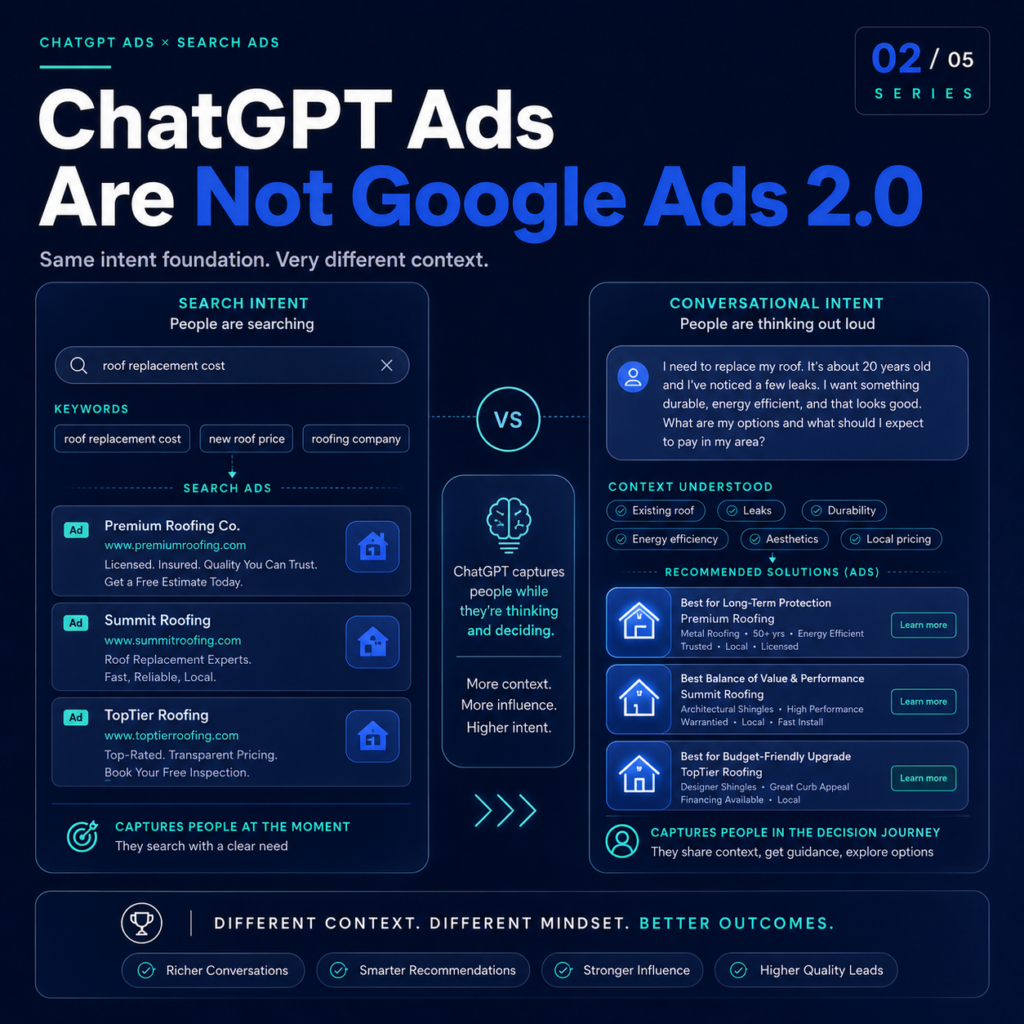
The obvious comparison is Google Ads.
And there is a good reason for that.
Both Google Ads and ChatGPT Ads are built around intent.
But the type of intent is different.
Google captures people when they search.
ChatGPT captures people while they are thinking.
That is a subtle difference, but it is a very important one.
Someone on Google might search:
“best washing machine under €400”
Someone on ChatGPT might ask:
“I need a reliable washing machine for a family of four. I don’t want anything too expensive, but I want something that will last. What brands should I consider?”
That is not just a keyword.
That is context.
It includes budget sensitivity.
It includes household size.
It includes reliability concerns.
It includes uncertainty.
It includes comparison behaviour.
OpenAI’s own guidance describes ChatGPT Ads as a way to reach users as they “explore, compare, and decide” inside a conversational experience. It also says ad selection considers signals such as the context and intent of the conversation, landing page, ad title and ad copy.
That is where this becomes interesting for advertisers.
Because ChatGPT Ads may not simply be about bidding on keywords.
They may be about understanding the entire shape of a buying conversation.
Why Google Ads Discipline Could Become a Major Advantage
In Google Ads, strong account structure still matters.
Not because agencies enjoy making accounts complicated.
But because structure protects relevance.
A well-built account usually separates:
Search intent.
Brand and non-brand.
Product categories.
Service types.
High-intent and research-stage terms.
Landing page themes.
Commercial priorities.
Margin opportunities.
Local intent.
Budget control.
This is the “boring” work.
But it is also the work that usually decides whether a campaign scales profitably or slowly wastes money.
The same thinking could become even more important in ChatGPT Ads.
OpenAI says advertisers can provide context hints at ad group level. These hints describe the conversations, topics or keywords where a product or service may be relevant. Importantly, OpenAI also says these are not exact-match keywords and do not guarantee delivery in specific conversations.
That means advertisers should not think about ChatGPT Ads as a simple keyword copy-and-paste from Google Ads.
The better approach is likely to be:
tightly themed intent architecture.
Not just “washing machines”.
But:
Washing machines for families.
Budget washing machines.
Integrated washing machines.
Energy-efficient washing machines.
Appliance replacement emergencies.
Delivery and installation-led searches.
Free recycling-led searches.
Premium appliance comparison queries.
Each of those themes deserves different messaging.
Different proof points.
Different landing pages.
Different offers.
Different commercial expectations.
That is where skilled Google Ads thinking transfers well.
Not because ChatGPT Ads are identical to Google Ads.
But because disciplined intent mapping is still disciplined intent mapping.
The Landing Page May Matter More Than Ever
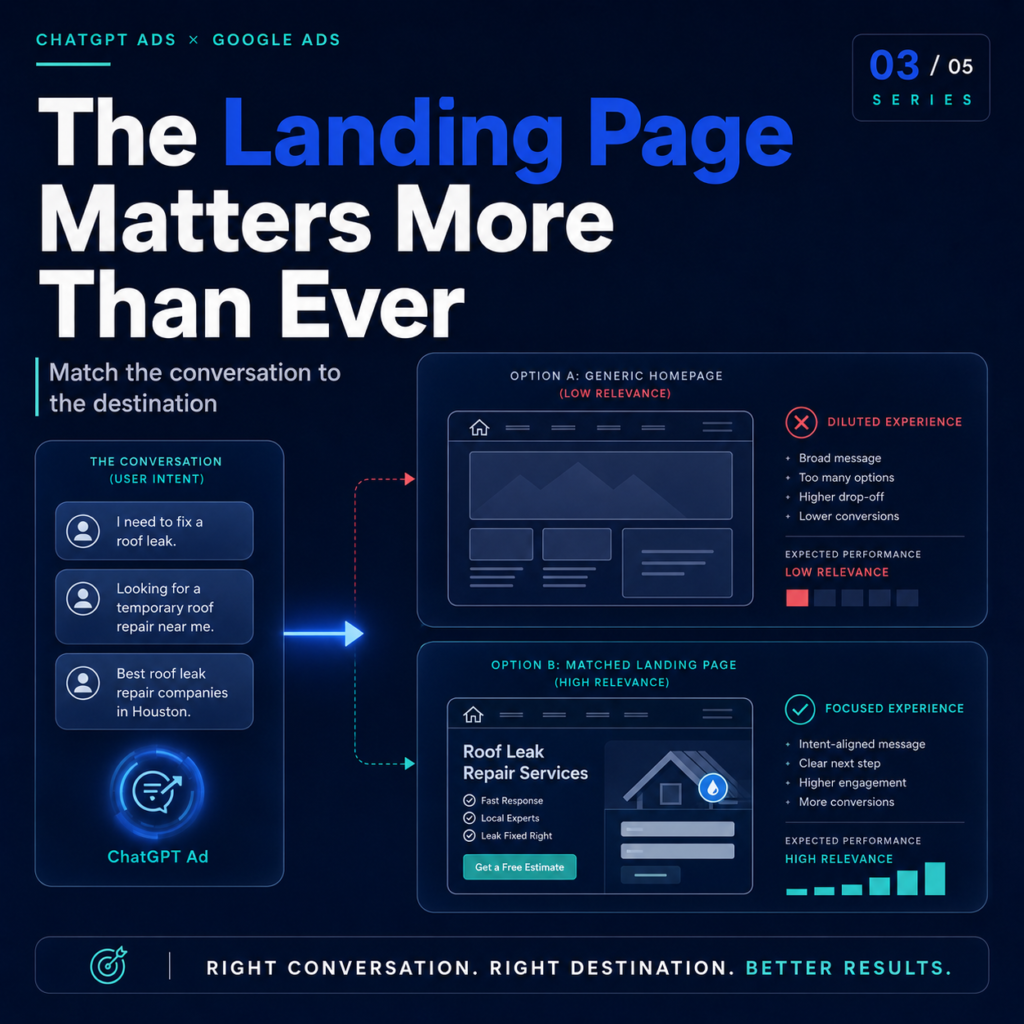
One of the biggest mistakes in Google Ads is sending too much traffic to the homepage.
It is easy.
It is lazy.
And it usually weakens performance.
If someone searches for “integrated dishwasher installation Dublin” and lands on a generic homepage, the experience is already diluted.
The same issue could be even more obvious in ChatGPT Ads.
Why?
Because the user has often given more context.
They may have explained their problem.
They may have compared options.
They may have mentioned budget.
They may have said they need something quickly.
They may have asked for a specific type of product or service.
So if the ad sends them to a generic page, the gap between the conversation and the destination becomes very visible.
The winning flow should look like this:
Conversation → intent theme → ad message → landing page → clear next step
Not:
Conversation → generic ad → homepage → confusion
For ecommerce retailers, this could mean building or improving category pages around actual buying scenarios.
For service businesses, it could mean creating specific pages for each commercial use case.
For B2B companies, it could mean matching ads to role-specific, problem-specific, or industry-specific landing pages.
The point is simple:
If ChatGPT understands the context of the conversation, your landing page needs to respect that context too.
ChatGPT Ads May Become a Mid-Funnel Weapon
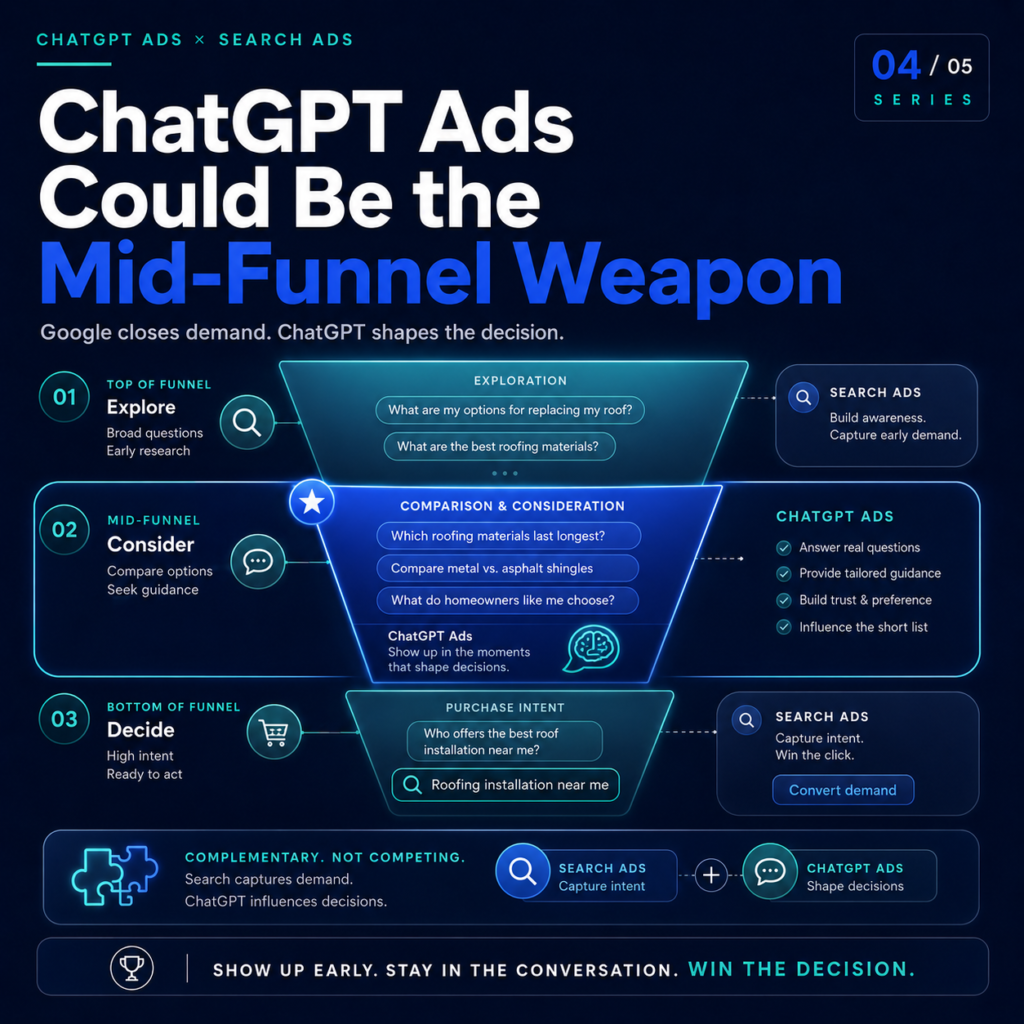
Google Ads is still extremely powerful when people know what they want.
Someone searches.
They compare.
They click.
They buy.
That behaviour is not going away.
Google Shopping, Search and Performance Max will continue to matter, especially for high-intent ecommerce and retail searches.
But ChatGPT may sit slightly earlier in the decision journey.
This is where the opportunity is.
People use ChatGPT when they are still figuring things out.
They ask:
“What should I buy?”
“What are the pros and cons?”
“What is the best option for my situation?”
“What should I avoid?”
“What is worth paying extra for?”
“What would suit me?”
These are not always bottom-of-funnel searches.
They are decision-shaping moments.
And decision-shaping moments are valuable.
OpenAI has also said that many ChatGPT conversations are “active and decision-oriented”, where people are learning about a category, comparing options, or deciding what to do next.
That is why ChatGPT Ads should not be viewed only as a Google Ads replacement.
A better way to think about it is:
Google captures demand. ChatGPT may help shape demand.
That makes it a complementary channel.
Especially for advertisers with products or services where customers need guidance before they are ready to buy.
Examples might include:
Home improvement.
Furniture.
Appliances.
Financial services.
Travel.
Software.
Education.
B2B services.
Healthcare-adjacent research.
High-consideration ecommerce.
Anything where the buyer needs to understand their options before they choose.
The Ad Group Thinking Still Matters
This is where I think some advertisers will go wrong.
They will treat ChatGPT Ads as a broad AI placement.
They will upload generic creative.
They will use vague landing pages.
They will expect the platform to do all the thinking.
That may work to a point.
But it is not where the serious advantage will be.
The better advertisers will likely build campaigns around very specific conversational themes.
For example, a roofing company might not simply create one broad “roofing” campaign.
They might separate:
Roof replacement.
Emergency leak repair.
Roof inspection.
Flat roof repair.
New roof cost.
Storm damage.
Energy-efficient roofing.
Local roofing contractors.
Each theme could have its own:
Context hints.
Ad copy.
Creative.
Landing page.
Call to action.
Proof points.
Measurement expectations.
That is very similar to what strong Google Ads managers have done for years with tightly themed ad groups.
The mechanics may differ.
But the discipline is familiar.
Relevance wins.
Structure wins.
Specificity wins.
What Advertisers Should Prepare Now
Even if a business does not have access to ChatGPT Ads yet, there is work it can do now.
And most of it will improve Google Ads performance anyway.
1. Audit Your Landing Pages
Look at your key product, category and service pages.
Ask:
Does this page match a specific user intent?
Is the next step obvious?
Is the offer clear?
Does the page answer the questions a buyer would naturally ask?
Does it give enough trust signals?
Is it built for conversion, or just information?
ChatGPT Ads will likely expose weak landing pages quickly.
2. Map Your Buying Conversations
Do not just map keywords.
Map questions.
What do customers ask before buying?
What objections come up?
What comparisons do they make?
What worries them?
What situations trigger demand?
What phrases do they use when they are unsure?
This is where ChatGPT-style intent becomes different from classic search intent.
3. Build Tighter Intent Themes
Group your products or services around real buying scenarios.
Not just what you sell.
But why someone needs it.
A furniture retailer, for example, might think beyond “dining tables” and into:
Small-space dining tables.
Family dining tables.
Extendable dining tables.
Luxury dining tables.
Apartment furniture.
Dining tables for Christmas hosting.
The tighter the theme, the easier it is to match ad copy, creative and landing page.
4. Improve Tracking
OpenAI has introduced pixel-based measurement and Conversions API to help advertisers understand what happens after someone engages with an ad, such as purchases, leads or sign-ups.
That is a clear signal.
Measurement will matter.
Advertisers should already be thinking about clean conversion tracking, server-side signals, lead quality, ecommerce revenue, and attribution.
Weak tracking will make it much harder to understand whether ChatGPT Ads are actually working.
5. Stop Thinking in Channels Only
The customer does not think in channels.
They might ask ChatGPT for advice.
Search Google for reviews.
Click Shopping results.
Visit the website directly.
Compare competitors.
Come back through remarketing.
Ask ChatGPT another question.
Then buy later.
That journey is messy.
So the strategic question is not:
“Will ChatGPT Ads replace Google Ads?”
The better question is:
“Where does ChatGPT Ads fit in the customer decision journey?”
Why This Could Suit Hard-Working PPC Agencies
There is a lot of hype in advertising.
Every few years, a new platform appears and people rush to declare the old one dead.
But most of the time, the winners are not the people shouting the loudest.
They are the people doing the work.
The ones who understand the account.
The ones who understand the customer.
The ones who know which products have margin.
The ones who know which landing pages convert.
The ones who know the difference between traffic and revenue.
The ones who know when automation needs better inputs.
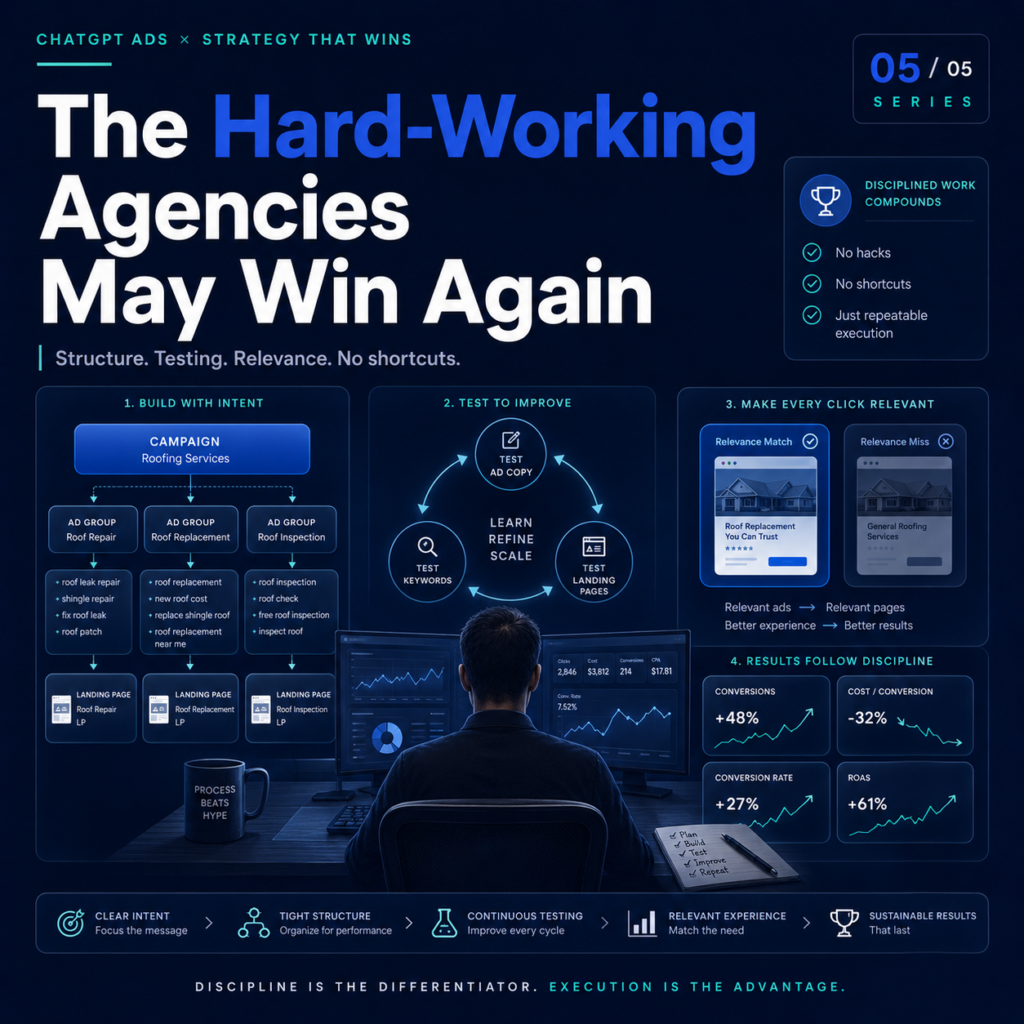
That is why I think experienced Google Ads agencies may have an advantage with ChatGPT Ads.
Not because they can simply copy Google Ads structures across.
They cannot.
But because they already understand the discipline of intent-based advertising.
They already know that broad relevance is not enough.
They already know that landing pages matter.
They already know that measurement matters.
They already know that a campaign is only as strong as the thinking behind it.
ChatGPT Ads may be a new environment.
But advertising craft still matters.
The Bottom Line
ChatGPT Ads are exciting.
But they should not be treated as magic.
They are not a replacement for strategy.
They are not a shortcut around poor landing pages.
They are not an excuse to stop thinking about structure.
If anything, they may increase the need for proper structure.
Because when advertising moves into a conversational environment, relevance becomes even more important.
The user is not just typing a keyword.
They are explaining what they need.
They are sharing context.
They are comparing.
They are deciding.
That creates a major opportunity for advertisers.
But only if the advertising experience respects the conversation.
My early view is this:
ChatGPT Ads will reward advertisers who understand intent deeply.
And the agencies who have spent years doing the hard, detailed work inside Google Ads may be better prepared than people realise.
Because the platform may change.
But the principle does not.
Structure builds relevance.